


The first half of 2026 has reminded investors that markets rarely move in a straight line.
From geopolitical tensions in the Middle East to inflation concerns, changing interest rate expectations, and continued conversations surrounding artificial intelligence (AI), investors have faced no shortage of headlines this year.
As we move into the second half of 2026, investors may benefit from focusing less on short-term noise and more on the long-term trends driving markets forward.
A Volatile Start to the Year
Stocks experienced a difficult first quarter, snapping a three-quarter winning streak for the S&P 500. The index declined 4.4% during the quarter, while the Nasdaq fell 7.0% as technology shares faced pressure tied to AI disruption concerns and shifting market leadership.
Much of the volatility centered around geopolitical developments involving Iran and instability in the Persian Gulf, which pushed oil prices sharply higher and reignited inflation concerns.
At the same time, investors continued adjusting expectations around Federal Reserve policy as inflation remained above the Fed’s long-term target.
Market Leadership Has Started to Broaden
One of the more important developments this year has been the rotation happening beneath the surface of the market.
While mega-cap technology stocks struggled early in the year, value stocks, small caps, energy, and materials companies outperformed. The Russell 2000 small-cap index gained 0.9% during the first quarter, outperforming many large-cap benchmarks.
The energy sector was the top-performing sector in the S&P 500 during the quarter, gaining 38.2% as oil prices surged amid geopolitical tensions.
This broadening market participation can often be a healthy sign for longer-term market trends.
Historic Momentum May Be Worth Watching
Recent market momentum has also been historically notable.
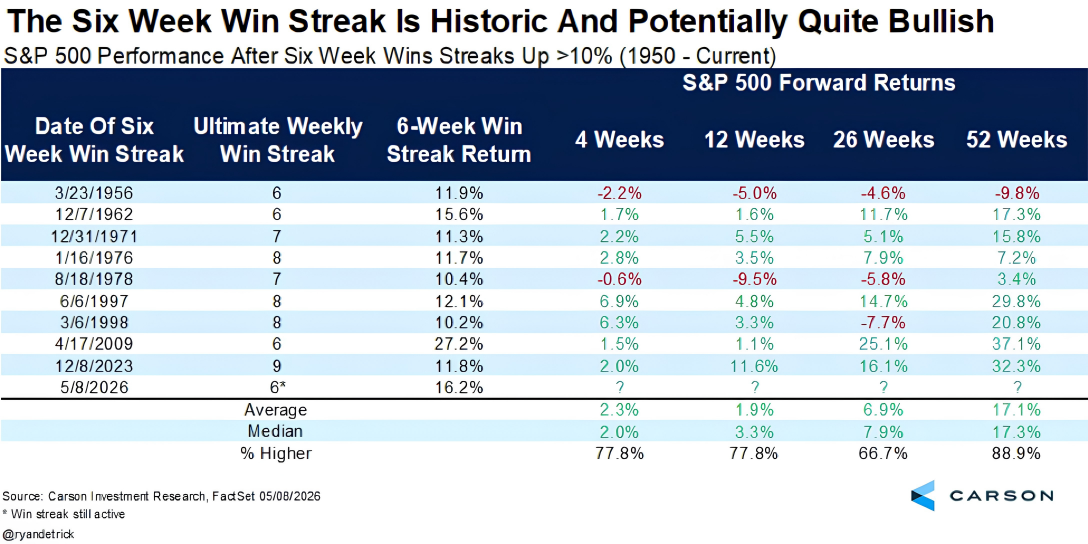
The S&P 500 recently completed a six-week winning streak of more than 10% — something that has only happened a handful of times since 1950. Historically, forward returns following these periods have generally been positive over longer timeframes, with the S&P 500 finishing higher 88.9% of the time one year later in prior examples.
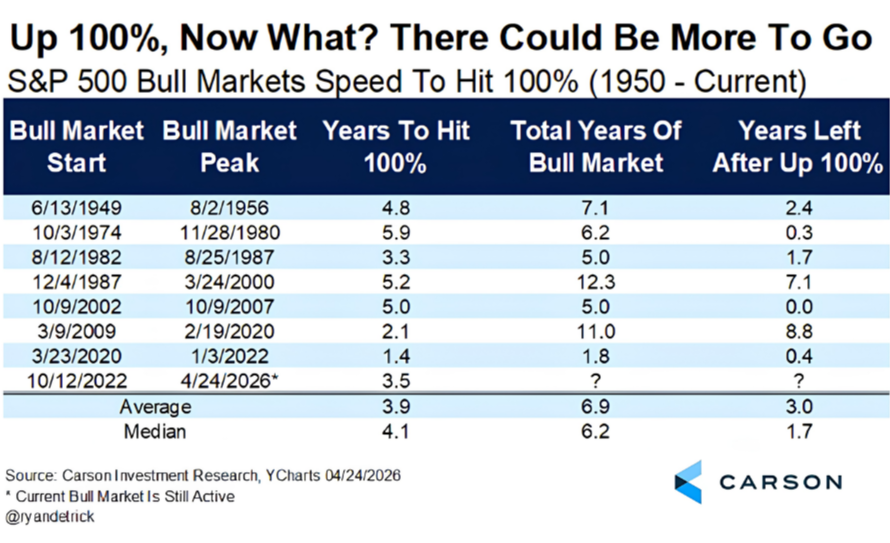
Another historical study showed that after bull markets reach a 100% gain, they have historically often continued higher for several additional years rather than ending immediately. While history never guarantees future results, the data serves as a reminder that strong rallies do not automatically signal the end of a bull market.
Bonds and Interest Rates Remain in Focus
Fixed income markets continue adjusting to a different environment than investors experienced over much of the last decade.
Treasury yields moved higher during portions of the quarter as markets reacted to inflation concerns, elevated government debt levels, and shifting expectations around Federal Reserve policy.
There has also been growing attention surrounding elevated Treasury issuance and the possibility of a less interventionist Federal Reserve moving forward.
At the same time, global fixed income markets may be presenting additional opportunities for diversification and income generation. Non-U.S. fixed income markets now represent more than 60% of the global bond opportunity set.
What Investors May Want to Watch in the Second Half
Several themes are likely to remain front and center throughout the remainder of 2026:
- Inflation and Federal Reserve policy
- Geopolitical developments
- Corporate earnings growth
- AI investment and productivity trends
- Government debt and Treasury issuance
- Labor market conditions
The Bottom Line
The first half of 2026 has been a reminder that markets can face periods of uncertainty even when the broader economic backdrop remains relatively healthy.
While headlines may continue to drive short-term swings, history has consistently shown that disciplined, long-term investors are often rewarded for staying focused on their plan rather than reacting emotionally to volatility.
At Harvest Point® Wealth Management, we continue monitoring the evolving market landscape while helping clients make thoughtful, long-term financial decisions rooted in stewardship, wisdom, and purpose.
Sources:
- LPL Research
- Carson Investment Research