


Rate Cuts
As anticipated, the Federal Reserve cut interest rates by 0.25% at its September meeting. Fed Chair Jerome Powell called it a “risk-management cut,” saying the labor market is starting to weaken. Job growth has slowed, and the Fed expects to lower rates two more times in 2025 and once more in 2026.
The Fed also raised its outlook for economic growth in 2025–2026 and expects slightly lower unemployment. Inflation, however, is forecast to be a bit higher. While not all policymakers agreed on the pace of cuts, markets were encouraged to see rate reductions back on the table. Stocks have already responded with record highs following the announcement.
What History Tells Us
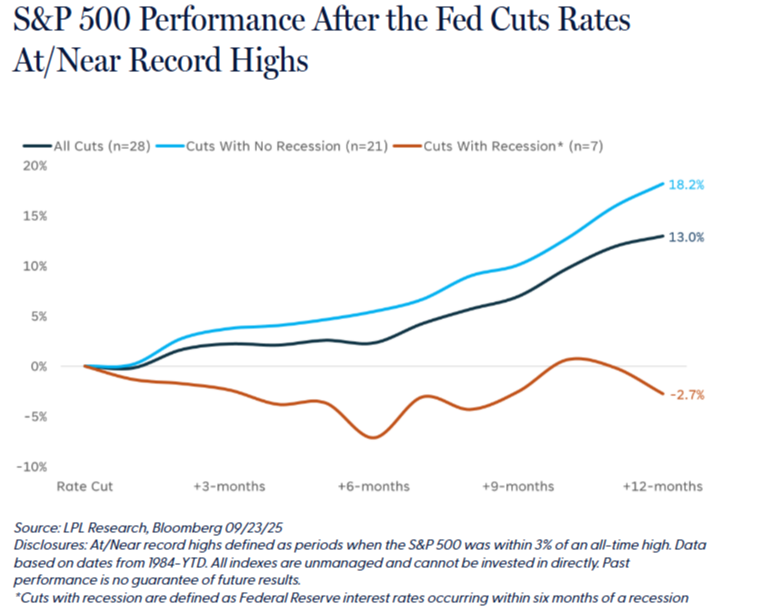
Looking back, when the Fed has cut rates near record stock market highs, the S&P 500 has usually gone up, although past performance is no guarantee of future results. Since 1984, markets rose an average of 13% in the year after such cuts, with 93% of those times posting gains. If there wasn’t a recession, returns were even stronger—averaging 18%. But if a recession followed, stocks often fell.
Labor Market Concerns
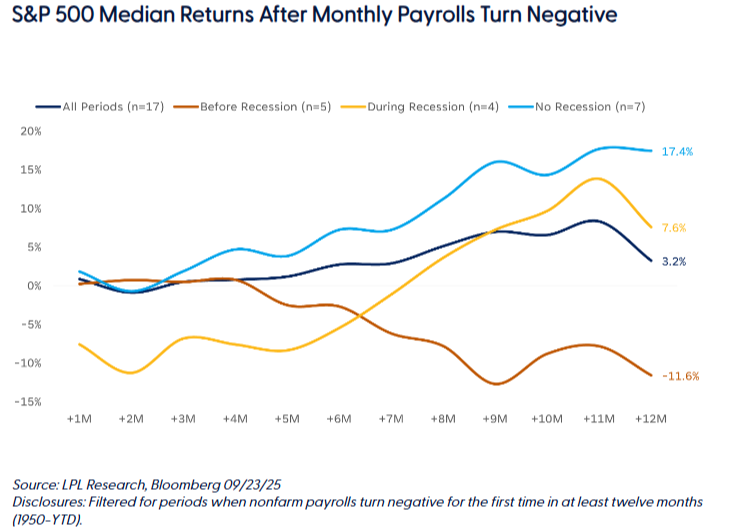
The job market is flashing warning signs. Payroll data was revised downward by 818,000 jobs for the 12 months ending March 2024, and recent reports show very weak hiring. In fact, June posted the first negative jobs number in over four years. Historically, when job growth turns negative, market results are mixed. If a recession follows, returns drop. If the economy avoids a downturn, stocks usually do well.
Government Shutdown
Impact on Equity Markets
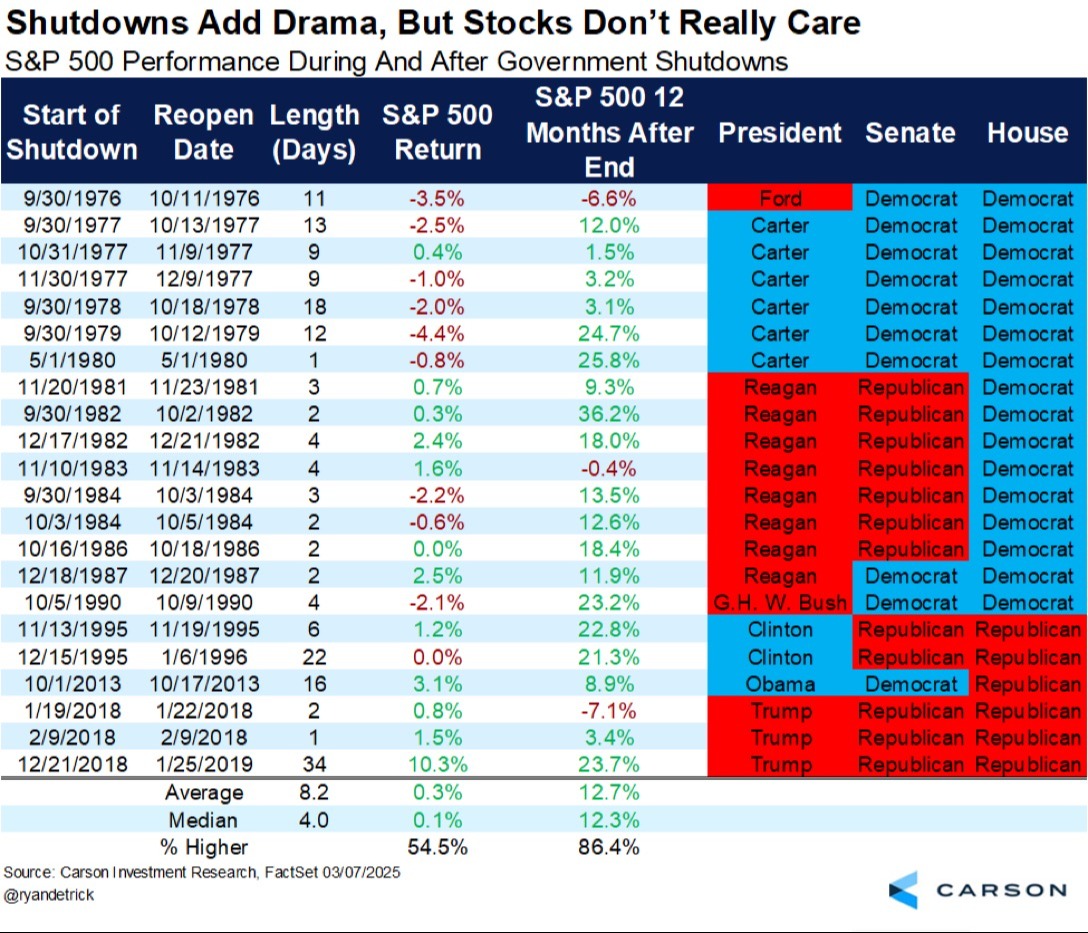
The U.S. government officially shut down this week. While that headline may sound alarming, history shows shutdowns don’t usually cause lasting damage to the stock market. In fact, stocks often dip before a shutdown begins, as investors price in the risks ahead of time. For example, the S&P 500 fell 7% and 5% in the weeks leading up to two shutdowns in 2018–2019. Last week, the index slipped 0.3%. While markets may be a bit more volatile in the coming days—especially if economic data like Friday’s jobs report is delayed—much of the impact may already be behind us.
Below is a chart from Carson Investment Research, detailing the previous 22 U.S. government shutdowns. In 19 of those cases, the S&P 500 was higher one year later, averaging a 13% gain. Notably, the S&P 500 has also managed to post a slightly positive return during the shutdown periods themselves. This serves as a good reminder that shutdowns are typically more of a headline risk than a lasting market threat.
Impact on Bond Markets
With the government now shut down, the cornerstone of fixed income markets—the U.S. Treasury market—remains largely unaffected. The Treasury Department continues to make coupon payments and conduct debt auctions, since these operations are considered essential to protecting the nation’s creditworthiness. While shutdowns primarily impact non-essential discretionary spending, borrowing activities proceed under well-established contingency plans.
Historically, government shutdowns have not been very eventful for the bond market. In fact, they can provide a bit of short-term relief, as Treasuries often rally when uncertainty rises. During the last three shutdowns, 10-year Treasury yields moved slightly lower, averaging a 0.05% decline. For example, during the 2013 shutdown, the 10-year yield fell by 0.02%. That said, the three major rating agencies—Moody’s, Fitch, and S&P—have warned that shutdowns reflect negatively on the U.S. government’s bond rating. Each has already downgraded U.S. credit in recent years due to fiscal and political challenges.
Since 1976, there have been more than 20 shutdowns, lasting about 100 days in total. In every case, Treasury operations continued without interruption. The department’s contingency plans ensure debt issuance proceeds smoothly, and the Federal Reserve Bank of New York facilitates the process. Market effects have usually been short-lived, with Treasuries often serving as a safe haven and long-term yields edging lower once shutdowns end. Importantly, no shutdown has ever stopped debt issuance—avoiding the risk of missed interest payments, something Congress has always moved to prevent.
The Bottom Line
Rate cuts have often been good news for markets, and LPL Research believes recession risk is still low for now. Growth could be helped by lower borrowing costs, new government spending, and rising productivity. Still, with the labor market softening and political risks in play, investors should stay watchful. Even in a strong bull market, periods of cooling off are normal—and may provide good opportunities to buy for the long term. The key is to stay focused on your bigger financial plan rather than short-term noise.
Want a Second Opinion?
With so many moving pieces—Fed decisions, labor trends, and political uncertainty—it’s important to know if your plan is built to withstand volatility. At Harvest Point®, we offer a complimentary second opinion on your financial picture through our Discovery Questionnaire. By filling it out, you’ll help us understand your goals and concerns so we can guide you toward wise stewardship and long-term confidence.
Sources:
LPL Research
Carson Research
Important Disclosure:
This material is for general information only and is not intended to provide specific advice or recommendations for any individual. There is no assurance that the views or strategies discussed are suitable for all investors. To determine which investment(s) may be appropriate for you, please consult your financial professional prior to investing.