


The IRS has increased the standard deduction for 2026 to $16,100 for single filers and $32,200 for married couples filing jointly. For many taxpayers, the standard deduction is greater than the total deductions they could claim by itemizing.
While a higher standard deduction can be beneficial, it also means that certain expenses, including charitable contributions, may not provide an additional tax benefit. Fortunately, there is a strategy that could help you make the most of your generosity: charitable gift bunching.
Before diving in, it's important to note that I am not a tax professional. Before making significant changes to your charitable giving strategy, consult with your tax professional to determine what makes sense for your situation.
What Is Charitable Gift Bunching?
Wouldn't it be great if you could receive a greater tax benefit from the charitable gifts you're already planning to make? That's the idea behind charitable gift bunching.
Rather than spreading charitable contributions evenly across multiple years, bunching involves combining several years' worth of donations into a single tax year. This can allow you to itemize deductions in one year while taking the standard deduction in the years that follow.
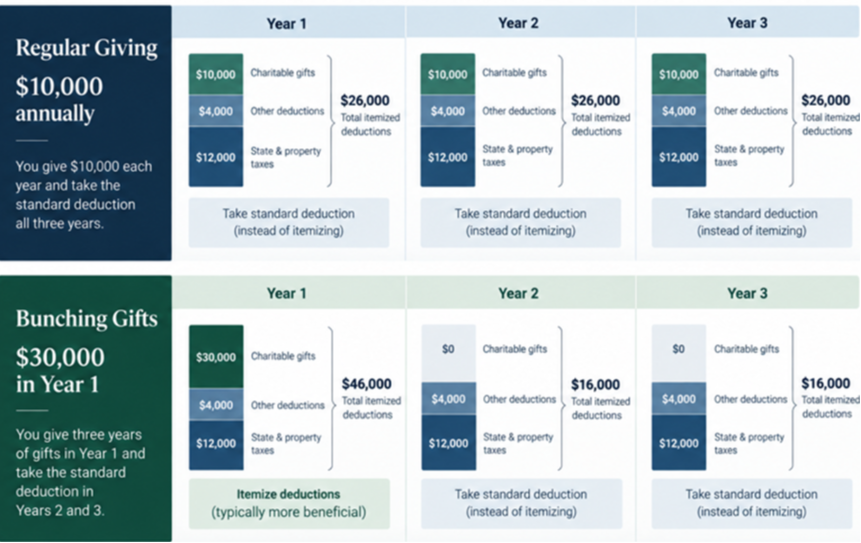
For example, let's say you and your spouse have $12,000 in annual state and property taxes, $4,000 in other eligible deductions, and give $10,000 to charity each year.
Your total itemized deductions would be $26,000 annually, which falls below the $32,200 standard deduction for married couples filing jointly in 2026. As a result, taking the standard deduction would generally be more beneficial.
However, what if you combined three years of charitable giving into one?
Instead of donating $10,000 annually, you could contribute $30,000 in 2026. Combined with your other deductions, this would bring your potential itemized deductions to $46,000 before applicable charitable deduction limitations.
You could then take the standard deduction in 2027 and 2028, assuming your circumstances remain similar.
The total amount you give to charity hasn't changed, but the timing of your gifts could result in greater overall tax savings.
Timing Matters
While 2026 was used in the previous example, that doesn't necessarily mean it's the best year for you to bunch your charitable gifts.
For starters, bunching needs to take place during the calendar year it is claimed in—you cannot bunch giving from previous years.
Charitable bunching can be especially beneficial during years when you expect your taxable income to be higher than usual. Examples might include:
- Your final year of employment before retirement
- A year with substantial bonuses or business income
- A year when you realize significant taxable investment gains
Of course, not every increase in income can be anticipated. However, if you know a higher-income year is approaching, charitable gift bunching may be worth considering as part of your overall tax strategy.
Donor-Advised Funds
You do not need a special account to be able to bunch charitable gifts—documenting the ongoing gifts is what the IRS needs to see
However, if you want an organized account for this giving, and more control over the timing of your gifts, a Donor-Advised Fund (DAF) may be perfect for you.
A DAF is a charitable giving account that allows you to make contributions now and recommend grants to qualified charities over time. Rather than donating directly to multiple organizations each year, you can contribute a larger amount to a DAF in one year and recommend distributions to your preferred charities in future years.
This allows you to receive a charitable deduction in the year you contribute to the fund while maintaining a consistent giving schedule for the organizations you support. Contributions to a DAF are irrevocable, and grants remain subject to the sponsoring organization's approval.
Tax Considerations
Beginning in 2026, two notable changes to charitable giving deductions make it especially important to evaluate your options.
First, taxpayers who take the standard deduction may now deduct up to $1,000 in qualifying cash charitable contributions, or $2,000 for married couples filing jointly. This provides an opportunity for eligible taxpayers to receive a tax benefit from charitable giving even without itemizing deductions.
Second, a new 0.5% adjusted gross income (AGI) floor applies to charitable deductions for taxpayers who itemize. This means that, generally, only qualifying charitable contributions exceeding 0.5% of your AGI are deductible, subject to other applicable limitations.
While this new floor limits some charitable deductions, it also creates another potential advantage for bunching. By combining several years of giving into one year, you may only have to account for that 0.5% floor once rather than in multiple years.
These changes don't necessarily make bunching the right choice for everyone, but they reinforce the importance of planning when and how you give.
Give With Purpose, Plan With Intention
At the end of the day, charitable giving is about supporting the people, organizations, and causes that matter most to you. Thoughtful planning can help you continue making that impact while potentially improving your tax situation.
As with any tax strategy, it's important to consult with your tax professional to determine whether charitable gift bunching makes sense for your circumstances.
If donor-advised funds caught your attention, or you're looking for guidance on how charitable giving fits into your broader financial plan, we invite you to start by completing our Discovery Questionnaire. We'd love to learn more about your values and goals and explore whether Harvest Point® Wealth Management would be a good fit to serve you.